My head starts to hurt when I think about this philosophically disturbing question. It seems like a chicken egg problem but yet it has been described as the fundamental difference between the laws that govern the macro-world and the phenomena in the micro-world.
Being a pre-sales engineer and a science maniac, I enjoy figuring out seemingly complicated problems and explaining the possible solutions to people in a way they would easily understand. However, I have been having trouble explaining faith to people, especially to my engineer colleagues. The common explanation in Christianity about faith is that “you know what you know what you know”. But, that explanation just doesn’t make sense to the science world where everything needs to be proved.
The Bible says that faith is a substance of things (Hebrew 11:1), so faith is something real. But how? I didn’t get an answer until I ran across Quantum Physics. I started to see the glimpse of light in the midst my own foggy confusion. Gradually, I began to obtain a clearer picture of how things are connected and how faith can possibly work. Science has started to catch up with what God said in the Bible thousands of years ago. Let me explain.
The Emergence of Quantum Physics
In the beginning of the 20th century, there was a physics catastrophe. There were several experiments such as the Rutherford and Rayleigh-Jeans experiments which couldn’t be interpreted by Classical Physics. Quantum Physics emerged. It studies the micro-world that behaves completely differently than what we consider to be normal. It is absurd and crazy.
First, let’s take a look at the concept of superposition.
Superposition
Quantum Physics says that until a particle is measured and observed, it actually exists in all the states it could possibly be in simultaneously. This is referred to as the particle being in superposition.
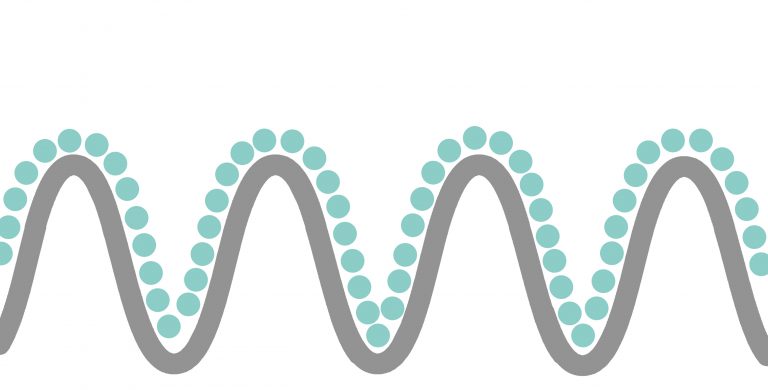
When the particle is measured, superposition collapses and the particle assumes one state over all of the other possible states. This is the state that our measuring instrument observes.

Since all matter is made up of particles, superposition applies to larger objects. When we observe the world, it behaves very differently than when we are not observing it. While we are not looking at an object, in general, it acts like it’s in many states at once, and when we measure or observe the object, our object is forced to fall into just one state.
That’s a pretty troubling thought. While we’re not looking, the world is acting completely crazy, but as soon as we turn around, it pretty much acts normal.
We can never really directly observe superposition because when we try to do so, we are forcing nature to collapse into one state and superposition doesn’t exist anymore. This is the mind boggling thing about Quantum Mechanics.
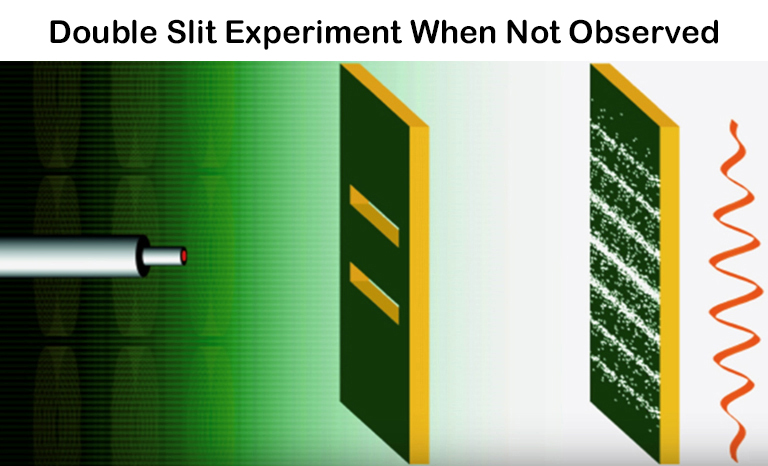
As difficult as these ideas are to believe, countless experiments have shown us that superposition is real. In the famous double-slit experiment, when electrons are not observed, they go through two slits at the same time and form the interference pattern.
However, when detectors were set up to observe particles going through the slits, the electrons had to go through one slit or the other. Therefore, the particles were formed into two piles on the other end.
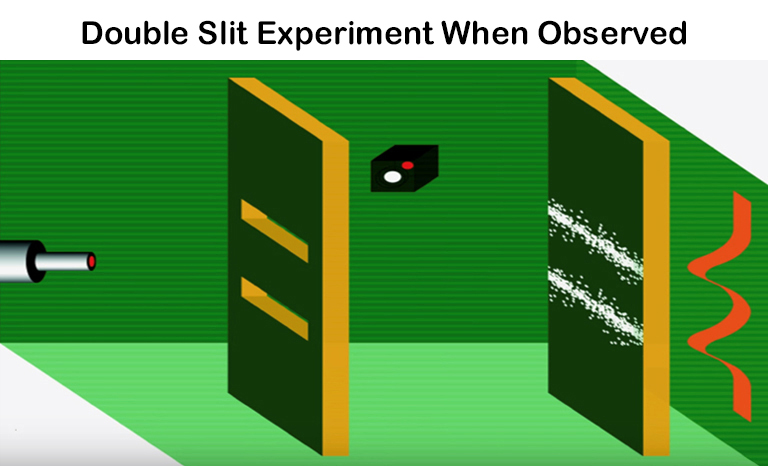
Professor Jim Al-Khalili explained this experiment perfectly (watch the video below) and you can win the Nobel prize too if you can explain why.
Schrödinger tried to explain superposition to Einstein by using a larger object: a cat. In his thought experiment, a cat is placed in a covered box with a radioactive sample that has a 50 percent chance of decaying and killing the cat. When the box is covered, according to common sense, we presume that the cat is either dead or alive. However, if we think of the cat like a particle and apply the superposition principle, we would say that the cat was both dead and alive at the same time because it was not being observed.
When we open the box, we are taking a measurement of the cat’s aliveness, so the cat has to immediately become one or the other, and there is no way we can observe what just happened to the cat when the box was closed because superposition can’t be seen.
So really, our curiosity makes the cat alive or kills the cat. The outcome of the experiment depends on which option we choose. If we choose the cat to be alive, then we force nature to decide that the cat should live, or if we think the cat is dead, then we kill the cat.
But we’re like the cat too, everything around us exists in a superposition fashion. The Many Worlds Theory states that anything that can happen does happen. So when Schrödinger’s cat was observed, in one universe the cat was found to be dead and in another universe the cat was found to be alive. Every time there are one or more possible options available to the universe, there will be new universes created in which all possible outcomes come true. So there could be a universe where Hitler won the war, and there could be another universe where penicillin was never invented.
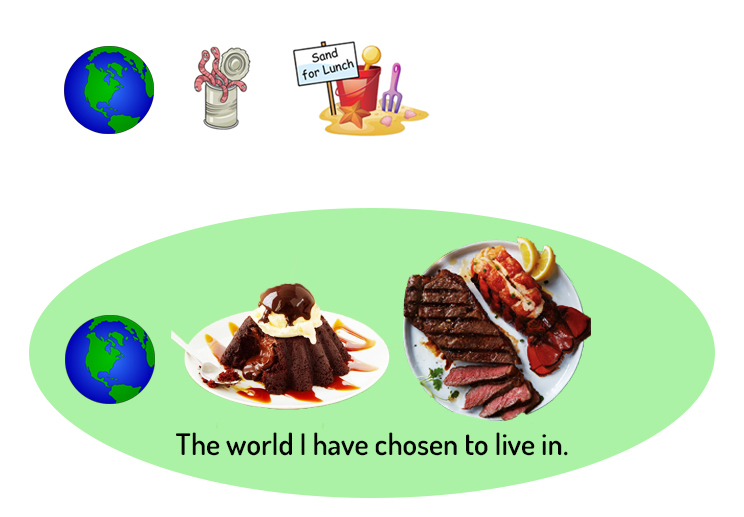
All things are possible and we have to choose our universe to live in.
In one universe, I could be eating sand and worms for lunch. In another universe, I could be eating chocolate. But who cares? I have already chosen the world where I can eat chocolate lava cakes everyday and steaks and lobsters as well.
But how is this related to faith? Lets take a look how Jesus explains faith.
Quantum Physics is the Scientific Proof of Faith
Jesus said that in God, everything is possible (Matthew 19:26). This reflects the superposition principle. Jesus also said that if anyone believes that he could move a mountain to the sea without doubt in his heart, it shall be done for him (Mark 11:23). This supports what quantum theory says about choosing one possibility over the others as an observer.
Jesus was explaining Quantum Physics in plain English. He didn’t use the terms particles, neutrons, electrons, or atoms, He used the powerful parable method (Mathew 13:13)
Jesus wants us to be in peace and joy and let God handle the rest (Matthew 11:28). He was talking about the Many Worlds theory. Which universe do you want to live in? All things are possible and we, as observers, make that choice. Happiness is a choice; Anger is a choice; Peace is a choice; and Chaos is a choice. Let’s choose the best universe and let God take us there.
Believing is seeing. This governs the philosophy of Quantum Physics. When we believe with our hearts and minds, we can and will affect the world around us. When we choose as observers, we make our own realities. Therefore, Quantum Physics is the scientific proof of Faith.
Now, let’s take this to a higher level. We are like the cat in the Schrödinger experiment. Who is observing us? Who forces us to have the thoughts we have? And who forces nature to choose one reality over the others?
Sign up for a blog subscription and we will discuss this topic next: “Quantum Objects and Wave Length- How do we increase the probability of what we prayed for?”